


Determination of Di(2-ethylhexyl) phthalate (DEHP) Content in Single-Use Plastic Blood Bags by UV Sp
Introduction:
Di(2-ethylhexyl) phthalate (DEHP) is commonly added during the manufacturing process of single-use plastic blood bags; however, DEHP is carcinogenic and teratogenic. If the residual DEHP content in blood bags exceeds the permissible limit, DEHP may enter the human body via the blood during clinical transfusions, posing a serious risk to patients. Therefore, it is crucial to establish a rapid method for detecting DEHP in single-use plastic blood bags. In the field of DEHP detection, commonly used analytical instruments include gas chromatography-mass spectrometry (GC-MS) and gas chromatography (GC). Although these instruments provide accurate results, they are expensive to purchase, complex to operate and have relatively long analysis cycles. This paper establishes a method for the rapid detection of DEHP based on ultraviolet spectrophotometry, which offers the advantages of simple operation, high detection efficiency and a short analysis cycle.
1 Experimental Section
1.1 Apparatus and Reagents
UV-visible spectrophotometer; liquid density balance; electronic analytical balance; electric heating constant-temperature forced-air oven.
DEHP standard solution, 99.7% purity; anhydrous ethanol (Yantai Far East Fine Chemicals). All reagents used in the experiment were of analytical grade, and the water used was grade 2.
1.2 Experimental Methods
1.2.1 Sample Preparation
1.2.1.1 Preparation of the Extraction Solution
Take 96 mL of anhydrous ethanol, add water to a final volume of 100 mL, to prepare a 96% ethanol solution. Take an appropriate amount of the 96% ethanol solution and prepare the extraction solution by mixing it with water in a ratio of ethanol (96%) : water = 11 : 12.
1.2.1.2 Preparation of Reference Solution
Accurately weigh 1.0000 g of DEHP, dissolve in ethanol (96%) and make up to 100 mL to obtain Intermediate Solution 1. Take 10 mL of Intermediate Solution 1, dilute with ethanol (96%) to 100 mL, and use this as Intermediate Solution 2. Accurately measure 1 mL, 2 mL, 5 mL, 10 mL and 20 mL of Intermediate Solution 2 into five 100 mL volumetric flasks, dilute to volume with the extraction solution to obtain a series of standard solutions with mass concentrations of 1 mg/100 mL, 2 mg/100 mL, 5 mg/100 mL, 10 mg/100 mL and 20 mg/100 mL, respectively.
1.2.1.3 Preparation of the test solution
Heat the extraction solution to 37 °C and inject it into an empty blood collection bag via a blood collection tube, filling the bag to half its nominal capacity. After expelling all air from the blood collection bag, seal the blood collection tube. Immerse the bag horizontally in a constant-temperature water bath at 37 °C and leave to stand for 60 minutes. Remove the blood collection bag and gently invert it 10 times to ensure thorough mixing. Subsequently, transfer the extraction solution from the bag to a glass flask to obtain the test solution.
1.2.2 Instrumental Analysis
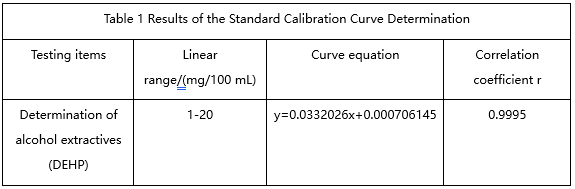
Using the extraction solution as the reference solution, the absorbance values of a series of standard solutions were measured at 272 nm. A standard curve was plotted with the concentration of each standard solution on the x-axis and the corresponding absorbance value on the y-axis. The results of the standard curve determination are shown in Table 1.
2 Results and Discussion
DEHP possesses certain detection characteristics, which allow for greater specificity in the selection of detection wavelength, extraction time and extraction temperature
2.1 Selection of Detection Wavelength
As different substances exhibit selective absorption of light at specific wavelengths, the key to detecting specific substances using a UV-Vis spectrophotometer lies in determining the characteristic absorption wavelength of the analyte. Analysis of DEHP’s absorption profile across the 200–800 nm wavelength range revealed that the highest absorbance value was observed at 272 nm; consequently, 272 nm was selected as the optimal detection wavelength for this experiment.
2.2 Selection of Extraction Time
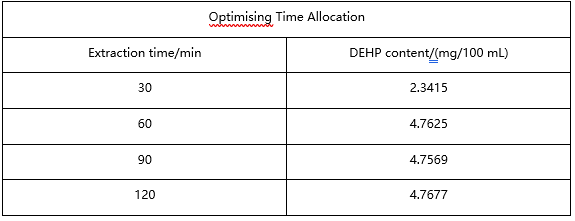
Extraction time is a critical parameter in the testing of medical devices. An excessively short extraction time results in incomplete extraction, leading to lower detection values; conversely, an excessively long extraction time increases testing duration and reduces testing efficiency. Consequently, this method investigated the extraction efficiency of DEHP under different extraction times, with the results shown in Table 2. As can be seen from Table 2, the DEHP detection values stabilised after an extraction time of 60 minutes. Therefore, 60 minutes was selected as the optimal equilibrium time for this experiment.
2.3 Selection of Extraction Temperature
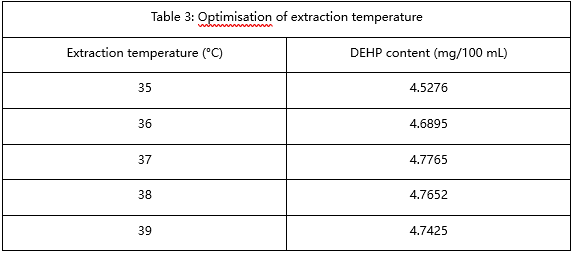
The selection of the extraction temperature is crucial to this method. As single-use plastic blood bags are primarily used in clinical blood transfusions, the optimal extraction temperature should be determined in conjunction with the clinical operating temperature (37 °C). If the temperature is too low, DEHP cannot be fully extracted, resulting in underestimated values; conversely, if the temperature is too high, it deviates from actual clinical conditions, rendering the test invalid. Consequently, this experiment investigated the detection performance of DEHP at different equilibrium temperatures (35 °C, 36 °C, 37 °C, 38 °C, 39 °C), with the results shown in Table 3. As can be seen from Table 3, the measured DEHP values show little variation and tend to level off within the extraction temperature range of 35–39 °C. Consequently, taking into account clinical application temperatures, the extraction temperature was set at 37 °C in this experiment.
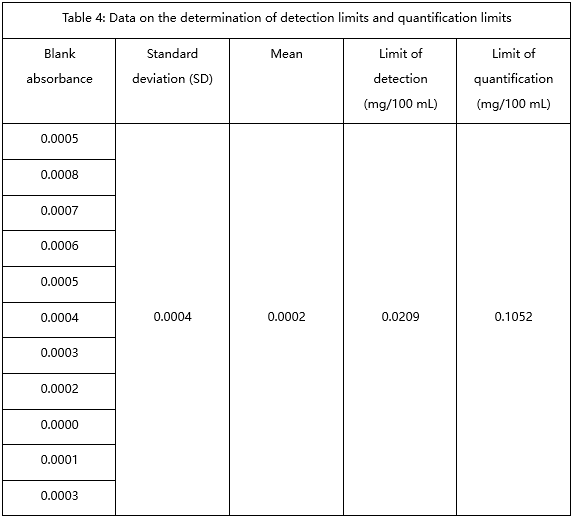
Eleven blank solutions were analysed in parallel, and the standard deviation of the absorbance values from the 11 determinations was calculated. The concentration corresponding to the mean blank value plus three times the standard deviation is defined as the method detection limit for each element, whilst the concentration corresponding to the mean blank value plus ten times the standard deviation is defined as the limit of quantification. The data are presented in Table 4. The detection limit is 0.0209 mg/100 mL and the limit of quantification is 0.1052 mg/100 mL; the results are satisfactory.
2.5 Method Precision
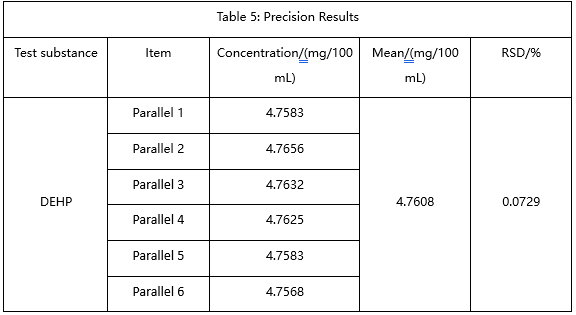
Six parallel determinations were carried out on the test solution, and the relative standard deviation (RSD) was calculated. The RSD for DEHP should not exceed 6%. As shown in Table 5, the RSD was 0.0729%, and the precision requirements were met.
2.6 Method Accuracy
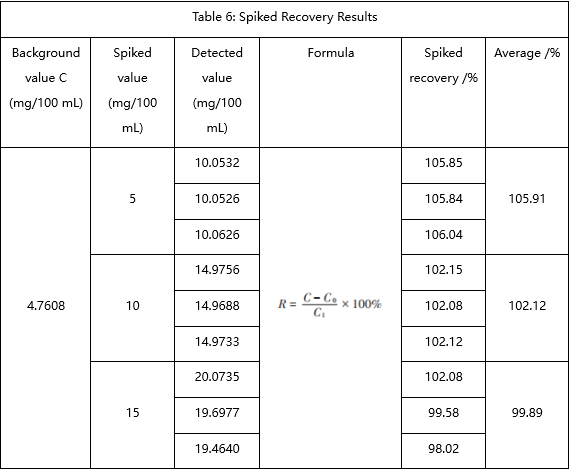
Accurately measure 5 mL, 10 mL and 15 mL of intermediate solution 1 into three 1000 mL volumetric flasks, dilute to volume using the extraction solution to obtain spiked solutions with mass concentrations of 5 mg/100 mL, 10 mg/100 mL and 15 mg/100 mL. Using these three spiked solutions as extraction solutions, conduct spiked recovery experiments. Each concentration was repeated three times; the mass concentration of DEHP in the spiked solutions was determined, and the spiked recovery rates were calculated. The acceptable range for recovery is 90%–110%. As shown in Table 6, the DEHP recovery rates fell within the range of 98.73%–100.56%, indicating that the accuracy meets the requirements.2.6 Method Accuracy
3 Conclusion