


Determination of bismuth dinitrate in Chenxianglu Bailu tablets by UV-visible spectrophotometry
Introduction
A UV-visible spectrophotometric method was established for the determination of bismuth dinitrate in Chen Xiang Lu Bai Lu tablets. The detection wavelength was 326 nm, with dilute hydrochloric acid used as the extraction solvent, and ultrasonic extraction was carried out for 20 minutes. The mass concentration of bismuth nitrosate exhibits a good linear relationship with absorbance within the range of 2.0999–15.7492 µg/mL, with a correlation coefficient of 0.9999; the recovery rate of spiked samples ranged from 105.3% to 108.9%, and the relative standard deviation of the results was 1.32% (n = 6). This method is simple and rapid to perform, yielding accurate, reliable and reproducible results, and can serve as a reference for the quality control and evaluation of the bismuth nitrosate content in Chen Xiang Lu Bai Lu tablets.
Chenxianglu Bailu Tablets are primarily composed of liquorice, rhubarb, Sichuan costus, Acorus tatarinowii, dried tangerine peel, sodium bicarbonate, magnesium carbonate, magnesium oxide and bismuth subnitrate. It is currently listed in the 1993 edition of the ‘Pharmaceutical Standards of the People’s Republic of China: Traditional Chinese Medicine Formulations (Volume 8)’, and possesses the therapeutic effects of strengthening the stomach, harmonising the middle burner, regulating qi and alleviating pain. It is indicated for the treatment of gastric ulcers, erosive gastritis, hyperacidity, acute and chronic gastritis, gastrointestinal neurosis and duodenitis. As one of the principal active ingredients, bismuth subnitrate acts to neutralise gastric acid and plays a key role in the treatment of conditions such as gastric ulcers.
Current quality standards specify a limit for bismuth nitrite content; however, the determination method requires prolonged high-temperature calcination and ash formation, followed by titration with a disodium ethylenediaminetetraacetate (EDTA) titrant; When following standard procedures, the colour at the titration endpoint tends to revert after the initial colour change, necessitating repeated titration until the colour stabilises. This results in a time-consuming titration process, difficulty in determining the endpoint, and a high margin for human error. Furthermore, the temperature and duration of the calcination and ashing process must be strictly controlled, which is a time-consuming procedure.
Existing studies on the quality control of Chenxianglu Bailu tablets have not addressed bismuth nitrite [1–7]. Existing methods for determining bismuth nitrite content include atomic absorption spectroscopy [8], Raman spectroscopy [9], volumetric analysis [10], and ultraviolet-visible (UV) spectroscopy. However, these methods are characterised by high instrument requirements, the need for complexing agents and indicator changes, and, in some cases, the necessity for calcination and ashing, which are time-consuming and labour-intensive, whilst also requiring relatively large sample volumes. Drawing on Reference [13], the authors have established a UV method for determining the bismuth nitrite content in Chen Xiang Lu Bai Lu tablets. This method is rapid, simple to perform, and yields accurate, reliable results with good reproducibility; it can be used for the quality control of bismuth nitrite in this formulation and provides a reference basis.
1. Experimental Section
1.1. Main Apparatus and Reagents
UV-Vis spectrophotometer.
High-precision electronic analytical balance.
Dual-frequency, temperature-controlled, computerised ultrasonic cleaner.
Ultrapure water system.
Bismuth nitrite reference standard: 99.90% purity.
Hydrochloric acid: analytical grade.
All water used in the experiment is ultrapure water.
Samples of Chen Xiang Lu Bai Lu tablets.
1.2 Preparation of Solutions
Reference solution: Accurately weigh 21.02 mg of bismuth subnitrate reference standard and place it in a 100 mL volumetric flask, add dilute hydrochloric acid and sonicate to dissolve, then make up to the mark. This serves as the bismuth nitrite reference stock solution. Accurately measure 2.5 mL of the aforementioned bismuth nitrite reference stock solution into a 50 mL volumetric flask, add dilute hydrochloric acid to the mark, and shake well to obtain a reference solution with a mass concentration of 10.4995 µg/mL.
Sample solution: Take 20 tablets (0.5 g each) or 40 tablets (0.3 g each) of the drug, weigh accurately, grind to a particle size not exceeding 250 µm, weigh out an appropriate amount (equivalent to approximately 20 mg of bismuth nitrite), place in a 100 mL volumetric flask, add dilute hydrochloric acid, sonicate for 20 minutes, allow to cool, add dilute hydrochloric acid to the mark, shake well, filter, then accurately measure 2.5 mL of the filtrate, place in a 50 mL volumetric flask, add dilute hydrochloric acid to the mark, shake well, to obtain the sample solution.
Negative control solution: Prepare a negative sample lacking bismuth nitrosate in accordance with the formulation ratios and preparation process of Chen Xiang Lu Bai Lu tablets, and prepare the negative control solution following the method for preparing the sample solution. Blank reagent solution: Take an appropriate amount of dilute hydrochloric acid; the solution is ready.
1.3 Sample Analysis
Take 32 batches of the prepared sample solutions and the reference standard solution, using the blank reagent solution for calibration, and measure them at a wavelength of 326 nm, recording the absorbance values. Calculate the bismuth subnitrate content w using the external standard method according to Equation (1).
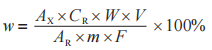
In the equation: AX — absorbance of the sample solution;
CR — concentration of the reference solution, mg/mL;
W — average tablet weight, g;
V — volume of sample dilution, mL;
AR — absorbance of the reference solution;
m — sample quantity, mg;
F — amount of bismuth subnitrate per tablet, g.