


How to use a spectrophotometer? A step-by-step guide to correct operation and data interpretation
01
PartⅠ: Abstract
For laboratory novices who are new to spectrophotometers, mastering standard operating procedures is essential. Incorrect operation not only affects data accuracy but may also damage the instrument. This article uses a common UV-Vis spectrophotometer as an example to explain the complete operating procedure.
02
Part Ⅱ: Preparations Before Operation
1. Warm-up: After switching on the instrument, allow it to warm up for at least 20 minutes to ensure that the light source and detector have stabilised.
2. Check the cuvettes: Ensure that the light-transmitting surfaces of the cuvettes are free from scratches and fingerprints; rinse them 2–3 times with the sample solution before use.
3. Set the wavelength: Set the required wavelength according to the experimental method (e.g., 595 nm for protein determination).
Step 1: Zero Calibration (Blank Calibration)
Place a cuvette containing the blank solution (usually a buffer solution or deionised water) into the sample chamber and close the lid. Press the ‘BLANK’ or ‘ZERO’ key; the instrument will automatically set the absorbance at this point to 0 or the transmittance to 100%.
Step 2: Sample Measurement
Remove the blank cuvette and insert the sample to be tested. Press the “READ” or “SAMPLE” key to read the absorbance value.
Step 3: Multi-point calibration (if quantification is required)
If concentration quantification is required, prepare a series of standard solutions of known concentrations, measure their absorbance, and plot a standard curve.
Step 4: Recording and cleaning
After recording the absorbance data, remove the cuvette, wash it immediately and leave it upside down to dry.
04
Part Ⅳ: Precautions for Data Reading
The optimal absorbance range is between 0.2 and 0.8. If the absorbance exceeds 1.0, the sample should be diluted and re-measured.
It is recommended that each sample be measured three times under the same conditions, and the average value taken.
Pay attention to the optical orientation of the cuvette (usually marked with an arrow); ensure it is placed in the same orientation each time.
|
Incorrect procedure |
Consequence |
Correct procedure |
|
Measuring without preheating |
Reading drift |
Preheat for at least 20 minutes |
|
Water droplets on the outer surface of the cuvette |
Light scattering |
Wipe dry with lens paper |
|
Measuring the sample without zeroing |
Systematic error |
Re-zero after each wavelength change |
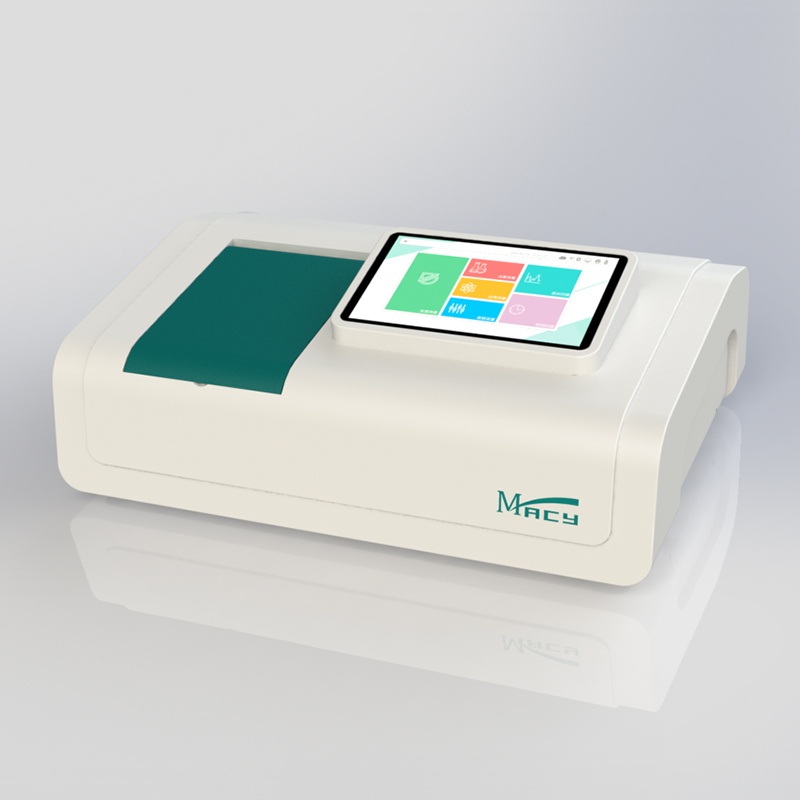
For experimental tasks requiring high precision and stability, choosing reliable equipment is particularly important. The UV-Vis spectrophotometers manufactured by Macylab offer one-touch zeroing, direct concentration readout and standard curve storage functions, significantly lowering the operational threshold.
Once you have mastered the correct operating procedures, you will obtain reliable, reproducible data.
MACYLAB INSTRUMENTS INC (hereinafter referred to as Macylab) is a high-tech enterprise with proprietary intellectual property rights. Macylab’s founding philosophy, “Technology—Changing for You”, serves as the company’s guiding principle, driving continuous exploration and bold innovation. Particularly in the field of analytical testing instruments, the company continually develops advanced products, establishing Macylab as a leading supplier of high-quality instrumentation.
Macylab specialises in spectroscopic instruments, including visible spectrophotometers, UV-visible spectrophotometers, atomic absorption spectrometers, atomic fluorescence spectrometers, ICP-AES and ICP-MS, as well as life science instruments such as ultra-micro spectrophotometers and fully automated nucleic acid extractors. Currently, our products are widely used in fields such as organic chemistry, inorganic chemistry, biochemistry, pharmaceuticals, environmental protection, metallurgy, petroleum and agriculture. Furthermore, leveraging its extensive experience in mechanical engineering, optical design, electrical engineering and software development, and in response to actual market demands, Macylab will soon be launching a series of analytical instruments.
Macylab places great emphasis on the recruitment and development of talent, as human capital is a core factor in a company’s sustainable development. Consequently, Macylab fully respects every employee, striving to achieve a genuine “shared platform for mutual growth”. To this end, Macylab has established a robust training team to provide comprehensive training for current staff and assist them in formulating career plans, with the aim of fostering mutual development between the company and its employees. At the same time, Macylab inspires its staff through a professional ethos centred on “family, dedication and learning”. Every member of the Macylab team approaches their work with boundless enthusiasm and professional expertise, ensuring that every instrument is perfected and every customer is served to the highest standard. This emphasis on and respect for talent infuses every aspect of the company with rigour and passion. Innovative design philosophies, exacting demands for high precision and performance parameters, and the continuous expansion of application scope are all perfectly reflected in the advanced nature of our products; From the rigorous inspection of raw materials, through standardised assembly-line operations across all production processes, to the strict final inspections by the quality control department, Macylab’s exacting standards at every stage of production have enabled the company to establish a comprehensive process quality control system, which is powerfully reflected in the quality of our instruments. Consequently, our products have received unanimous acclaim from users both domestically and internationally.
Macylab’s headquarters and production base are located in Shanghai, with a marketing centre in Beijing, and R&D facilities established in Shanghai, Beijing and Jiangsu. To fully utilise local intellectual resources, Macylab has engaged in in-depth scientific research collaborations with domestic and international research institutions, continuously transforming research outcomes into productive capacity. To better serve our extensive client base, Macylab maintains 12 domestic offices, providing bespoke application solutions tailored to your needs and enhancing product value. Whilst continuing to serve domestic users, Maclab has also established in-depth strategic partnerships with distribution networks in over 20 countries.
As Maclab accelerates its journey towards becoming a global brand in instrumentation, we continually raise our own standards. At the same time, we hope to receive the care and support of all sectors of society, so that we may look to the future hand in hand. Technology is bound to change because of you and me.