


Determination of Lithium, Nickel, Cobalt and Manganese Content in Secondary Battery Waste Using Indu
01
Part I: Introduction
Secondary batteries contain cathode materials such as lithium nickel cobalt manganese oxide, lithium manganese oxide, lithium cobalt oxide, nickel hydride powder, and lithium iron phosphate, alongside auxiliary materials including copper, iron, aluminium, graphite, binders, and separators. The cathode materials specifically contain valuable metals including nickel, cobalt, manganese, and lithium. Should discarded batteries be disposed of via simple landfill without analysis and recovery, irreversible environmental contamination and water pollution would ensue. Given the increasing scarcity of metals such as nickel, cobalt, and manganese, the recovery of valuable metals from secondary battery waste as secondary resources is imperative. The recoverable value varies according to the differing elemental content. Accurate determination of lithium, nickel, cobalt, and manganese content in secondary battery waste, coupled with the establishment of precise and reliable analytical methods, will significantly advance the recovery and utilisation of these metals.
Methods for determining manganese include gravimetric analysis, titration (potentiometric titration, ferrous ammonium sulphate titration), atomic absorption spectroscopy, and inductively coupled plasma spectroscopy; Methods for determining nickel include gravimetric analysis, titration (diketoxime separation-EDTA titration, direct EDTA titration), atomic absorption spectroscopy, and inductively coupled plasma spectroscopy; Methods for cobalt determination include titration (EDTA method, potentiometric titration, iodometric titration), spectrophotometry, atomic absorption spectroscopy, and inductively coupled plasma spectroscopy; Methods for lithium determination include atomic absorption spectroscopy and inductively coupled plasma spectroscopy. Zhang Ling et al. employed atomic absorption spectroscopy to determine the cobalt, nickel, and manganese content in lithium-ion battery cathode materials. Chen Ping et al. utilised chemical methods to measure the nickel, cobalt, and manganese content in lithium batteries. Xu Jinling employed high-concentration differential photometry, gravimetric analysis, and redox titration to determine nickel, cobalt, and manganese content in lithium-ion battery cathode materials. Huang Ruihong et al. analysed cobalt content in lithium nickel cobalt manganese oxide using high-concentration differential photometry. Tan Jingjin et al. determined nickel, cobalt, and manganese content in lithium-ion batteries via complexometric titration, potentiometric titration, and the difference-subtraction method. Cao Wenzhong et al. employed the standard addition method coupled with ICP-AES to simultaneously determine six elements—iron, cadmium, chromium, lead, tin, and copper—in spent batteries. The standard addition method is relatively cumbersome to operate and is not conducive to large-scale, streamlined testing. Wang Jing employed inductively coupled plasma optical emission spectroscopy (ICP-OES) to determine the major elemental content in lithium nickel cobalt manganese oxide. Gravimetric and volumetric methods typically involve lengthy procedures, are time-consuming and labour-intensive, and can only be applied to single elements. In contrast, ICP-OES requires only a single sample digestion, enabling simultaneous determination of multiple target elements with high efficiency and speed. The direct determination of lithium, nickel, cobalt, and manganese content below 20% in secondary battery waste using ICP-OES has profound significance. It exerts a positive and proactive effect on advancing the development and widespread adoption of the battery recycling industry, environmental protection initiatives, and the new energy sector.
02
Part II : Experimental Section
2.1 Reagents and Instruments
Hydrochloric acid, nitric acid, perchloric acid (analytical grade); Grade III water for laboratory use is sufficient; Lithium, nickel, manganese and cobalt standard reserve solutions (1000 μg/mL).
Inductively Coupled Plasma Emission Spectrometer (MACYLAB INSTRUMENTS INC.).
2.2 Experimental Method
2.2.1 Sample Preparation
Weigh 0.5 g (accurate to 0.0001 g) of sample. Place the sample in a 200 mL glass beaker, moisten with a small amount of water, add 15 mL HCl, and dissolve at low temperature for approximately 10 minutes. Add 5 mL HNO₃, heat at low temperature until the sample is completely dissolved, then remove and cool to room temperature. Transfer to a 500 mL volumetric flask, dilute to volume with water, mix thoroughly, and allow to settle until clear. Prepare a sample blank using the same method and determine according to the instrument's operating conditions.
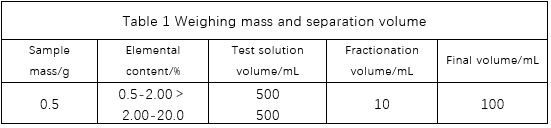
For elements exceeding the calibration curve, transfer the supernatant to a 100 mL volumetric flask as specified in Table 1. Add 10 mL HCl, dilute to the mark with water, and mix thoroughly。
2.2.2 Plotting the Calibration Curve
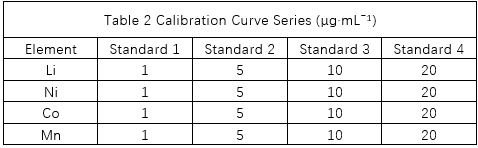
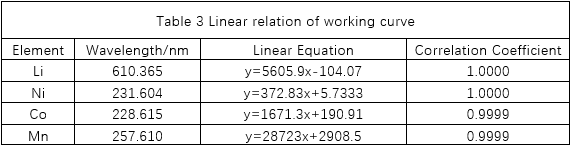
The mass concentrations of the mixed standard solution series were prepared according to the concentrations specified in Table 2. Measurements were conducted at the selected wavelength using ICP-OES. A calibration curve was plotted with the concentration of the target element on the x-axis and the emission intensity of the target element on the y-axis. The correlation coefficient of the calibration curve was ≥0.9999. The linear relationship of the calibration curve is shown in Table 3.
03
Part III: Results and Discussion
3.1 Selection of Sample Dissolution Methods
Two protocols were employed to dissolve Samples 1 to 4.
Method 1: Weigh 0.5000g of sample into a 250mL glass beaker. Moisten with a small amount of water, add 15mL HCl, and dissolve at low temperature for approximately 10 minutes. Add 5mL HNO₃ and heat at low temperature until the sample is completely dissolved. Remove from heat and cool to room temperature.
Method 2: Weigh 0.5000g of the sample into a 250mL glass beaker. Add 15mL hydrochloric acid and dissolve at low temperature for approximately 10 minutes. Then add 5mL nitric acid and 3mL perchloric acid. Continue heating
until dense perchloric acid fumes are emitted, then evaporate to a moist salt residue.
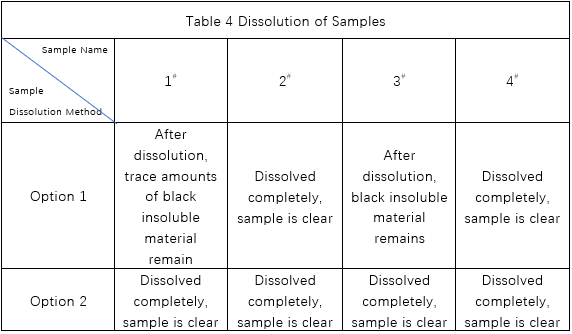
The dissolution of the sample using the above two methods is shown in Table 4.
A comparison of results between the turbid samples in Scheme 1 and Scheme 2 is presented in Table 5.
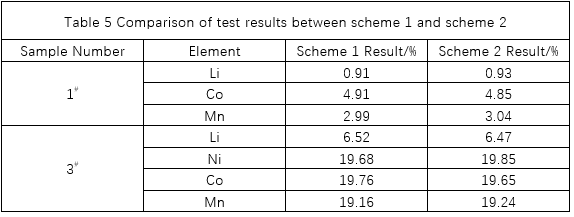
The results presented in Table 5 indicate that the turbid samples analysed under Method 1 largely correspond with those determined by Method 2. When dissolving samples using Method 1, black insoluble matter appeared in solutions 1# and 3#, attributable to the presence of a certain amount of carbon within the samples. Method 2 involves a more protracted procedure and necessitates the use of perchloric acid, posing environmental contamination risks. After comprehensive consideration, Method 1 was selected as the optimal sample dissolution method for this experiment.
3.2 Selection of Analytical Spectral Lines
Beyond lithium, nickel, manganese, and cobalt, secondary battery waste primarily contains approximately 10% carbon, 0.50% sulphur, 15% iron, 25% aluminium, and 20% copper. Results in Table 5 indicate that the presence of carbon and sulphur does not affect the determination of results. As the ICP-OES method simultaneously measures multiple spectral lines for various elements, several spectral lines for each target element were evaluated concurrently. Ultimately, the following lines were selected as analytical spectral lines due to their low interference, minimal background noise, and high signal-to-noise ratio: Li at 610.673 nm, Ni at 231.604 nm, Co at 228.615 nm, and Mn at 257.610 nm.
3.3 Influence of Interfering Elements
Beyond lithium, nickel, manganese, and cobalt, secondary battery waste primarily contains approximately 10% carbon (C), 0.50% sulphur (S), 15% iron (Fe), 25% aluminium (Al), and 20% copper (Cu). The results in Table 5 indicate that the presence of C and S has negligible impact on measurement outcomes. A 100 mL volumetric flask was charged with 2.5 mg Al, 1.5 mg Fe, and 2.0 mg Cu of interfering elements (added at the maximum matrix element concentration in the solution after dilution to the minimum dilution factor) and Li, Ni, Co, and Mn standard solutions to prepare mixed standard solutions at concentrations of 1.00 μg/mL and 10.00 μg/mL.
with concentrations of 1.00 μg/mL and 10.00 μg/mL. Their concentration values were determined according to the method, with results shown in Table 6.
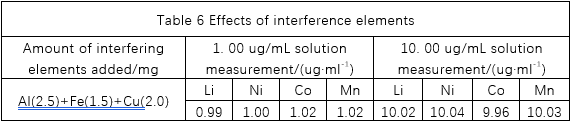
The results indicate that the interfering elements 2.5 mg AL, 1.5 mg FE and 2.0 mg Cu exerted negligible influence on the determination of Li, Ni, CO and Mn.
3.4 Precision Test of the Method
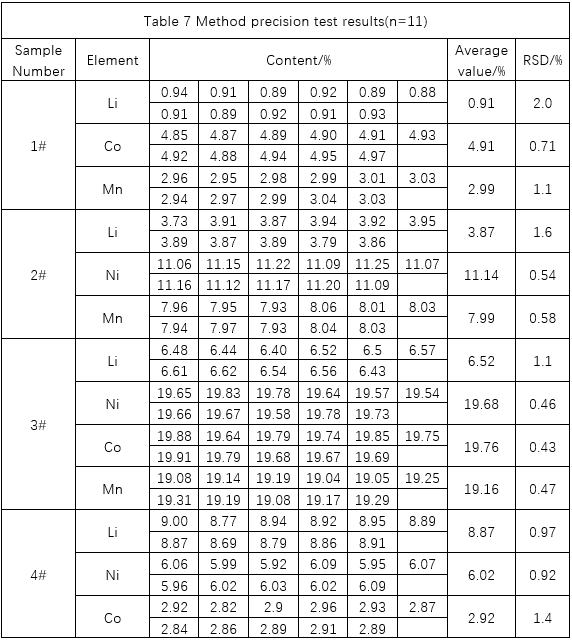
Weigh a series of 0.5 g samples of spent secondary battery materials (No. 1 to No. 4), accurate to 0.0001 g, and place them in 250 mL glass beakers. Process the samples according to the experimental method, then determine the Li, Ni, CO, and Mn contents under the selected optimal instrument conditions. Conduct 11 parallel determinations for each sample, with the relative standard deviation (n = 11, RSD) < 2%. This demonstrates the method's satisfactory precision, with results presented in Table 7.
3.5 Method Comparison Experiments
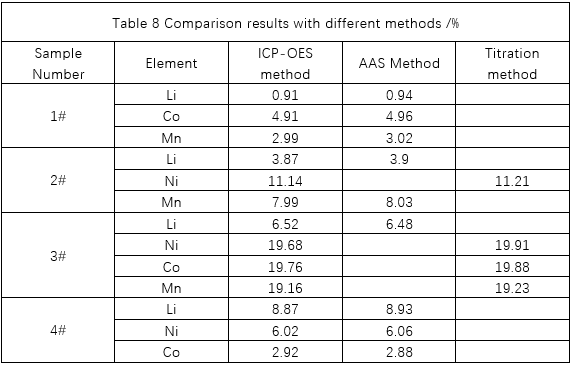
For secondary battery waste samples 1# to 4#, dissolution was performed according to the experimental methodology. Li, Ni, CO, and Mn were determined using ICP-OES, AAS (for Li; content ≤10% Ni, CO, and Mn), and titration (for content >10% Ni, CO, and Mn), respectively. The results obtained from the three methods were essentially consistent (Table 8).
4. Conclusions
This method employs a single-step sample dissolution to simultaneously determine four elements—lithium, nickel, cobalt, and manganese—in secondary battery waste. ICP-OES analysis is used for elements with ≤10% content (Ni, CO, and Mn), while AAS (Li) is applied for those exceeding 10% content. Titration is employed for elements exceeding 10% content (Ni, CO, and Mn). AAS (for Li; content ≤10% Ni, CO, and Mn) and titration (for content >10% Ni, CO, and Mn). Comparative results revealed that ICP-OES provides accurate and reliable measurements for lithium, nickel, cobalt, and manganese at concentrations below 20% in secondary battery waste. This method is simple, rapid, and easy to operate and implement, meeting the requirements for routine analytical testing.
04
Part IV: About Us
MACYLAB INSTRUMENTS INC is a high-tech enterprise possessing proprietary intellectual property rights. Guided by its founding philosophy, ‘Technology – Transformed by You,’ the company pursues continuous exploration and bold innovation. Particularly within the analytical testing instrument sector, it consistently develops advanced products, establishing MACYLAB as a premier supplier of high-quality instrumentation resources.
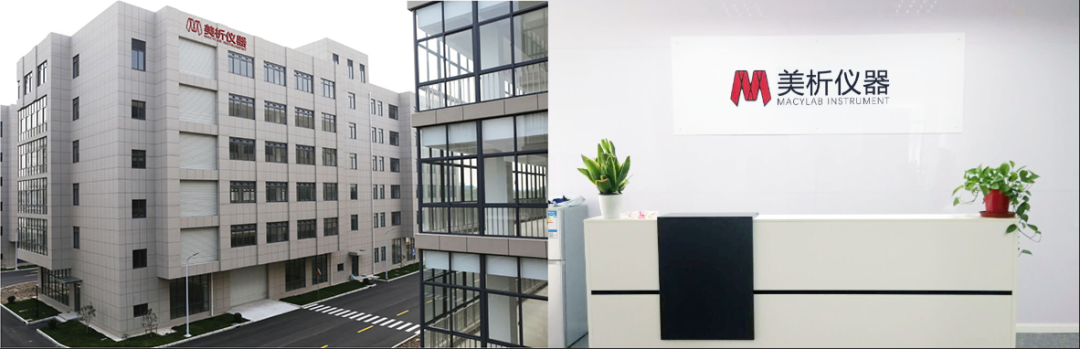
Macylab specialises in spectroscopic instruments: visible spectrophotometers, ultraviolet-visible spectrophotometers, atomic absorption spectrometers, atomic fluorescence spectrophotometers, ICP-AES, and ICP-MS. We also offer life science instruments: micro-volume spectrophotometers and fully automated nucleic acid extractors. Presently, our products are extensively utilised across organic chemistry, inorganic chemistry, biochemistry, pharmaceuticals, environmental protection, metallurgy, petroleum, and agriculture. Leveraging extensive expertise in mechanical design, optical engineering, electrical applications, and software development, Macylab will soon introduce a new range of analytical instruments tailored to market demands.
Macylab places paramount importance on talent acquisition and development, recognising human capital as the cornerstone of sustainable corporate growth. We uphold genuine respect for every employee, fostering an environment where ‘we build platforms together to realise individual potential’. To this end, Macylab has established a robust training team delivering comprehensive professional development programmes. We assist staff in formulating career plans, ensuring mutual advancement for both the company and its personnel. Simultaneously, Macylab inspires its workforce through the professional ethos of ‘family, dedication, and learning.’ Every Macylab employee approaches their work with fervent enthusiasm and professional expertise, ensuring the flawless delivery of each instrument and service to every client. This emphasis on talent and respect imbues every aspect of the company with rigour and passion. Our innovative design philosophy, stringent demands for high precision and performance parameters, and continuous expansion of application scope are all perfectly reflected in the advanced nature of our products. From stringent raw material inspection, through standardised assembly line processes, to rigorous final quality control, Macylab's exacting standards across production stages have established a comprehensive process quality control system. This is powerfully reflected in the quality of our instruments, earning consistent acclaim from users worldwide.
Macylab's headquarters and production base are located in Shanghai, with a marketing centre in Beijing. Research and development facilities are established across Shanghai, Beijing, and Jiangsu. To fully leverage regional intellectual resources, Macylab engages in deep scientific collaborations with domestic and international research institutions, continuously transforming research outcomes into productive capabilities. To better serve our extensive client base, Macylab maintains 12 domestic offices, providing bespoke application solutions tailored to your requirements and enhancing product value. While continuously serving domestic users, Macylab has established deep strategic partnerships with distributors in over 20 countries.
As Macylab accelerates its ascent among global premium instrument brands, we continually raise our own standards. We also earnestly seek the care and support of all sectors of society, inviting you to join us in looking ahead. Technology will inevitably change because of you and me.